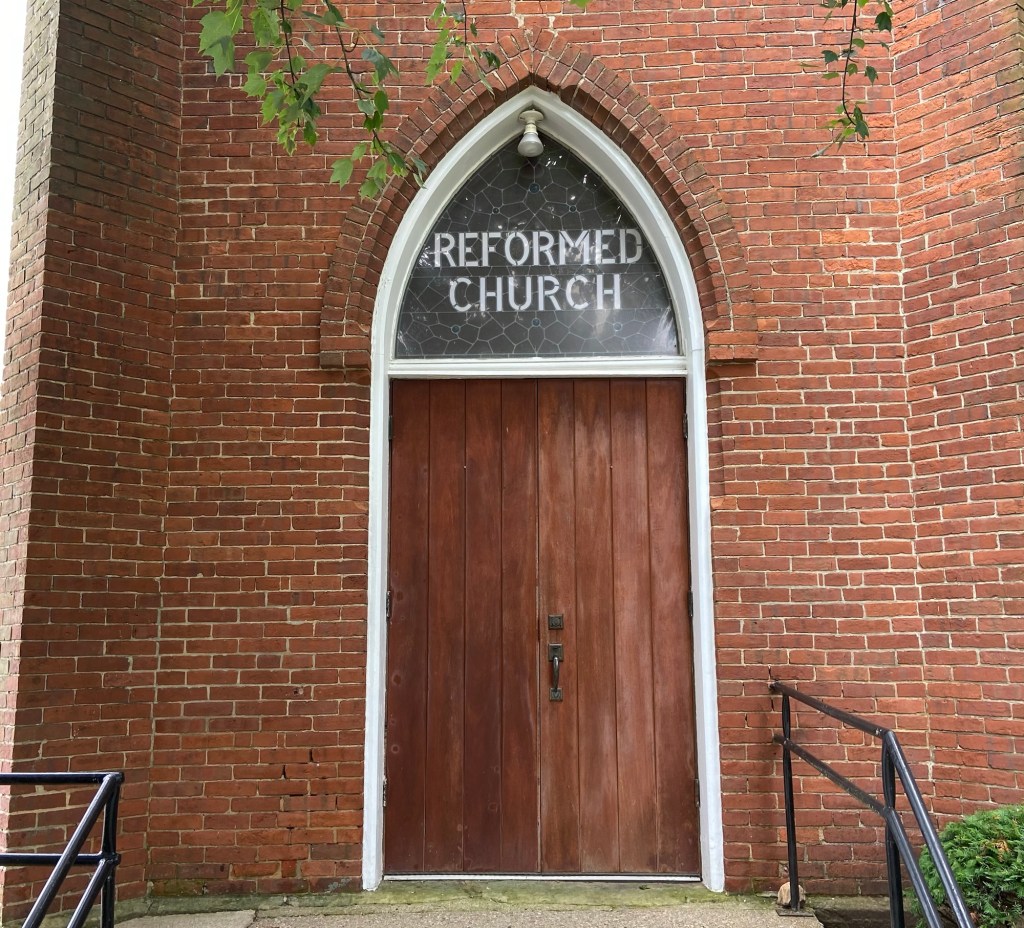
I was in 7th grade, my family still working through a fresh series of transitions that included my father leaving his last settled pastorate (which I wrote about) and a move to a new community. It would be my third school system and, thankfully, the last one. But it was all still so raw and tender at that point, and I was sorting through the emotional details. We all were.
But the bills still needed to be paid, and the call still needed to be answered, so my dad’s next pastoral move was to take a position as interim pastor of a small church not far away from our new home. Because my brother and I were so young at the time, we often had to tag along whenever he needed to be there for visits and other responsibilities.
I told this story recently on the podcast: during one of these visits, my brother and I wandered up to the sanctuary to look around, and I ended up snapping the top clip of a microphone stand. It still held the microphone, but I still felt guilty about it. I would feel guilty enough, in fact, that when I was recently invited to preach at this church, I finally confessed to what I had done some 30 years prior.
Of course, the mic stand was long gone, and nobody cared. But we did have a good laugh about it together, and that really was the point.
Just over five years ago, I preached another sermon. It was Easter Sunday, but not much about the day had felt joyful. This was April 2020, and it was my final Sunday at my church. As I had been doing for a few weeks, I set up my phone in my basement studio, hit the Live button on Facebook, and did my best to preach resurrection hope to whomever was tuning in.
Three months earlier, I had shared my resignation due to taking on a new position at the United Church of Christ National Ministries. It was the sort of position I had long been discerning and watching for, and everything had finally lined up in just the right way for me to pursue it. It was a good thing, too, because I had grown weary of the pastoral role. I was exhibiting many signs of burnout, and this move into a different sort of ministry was the right move for me. I was excitedly anticipating this new beginning that would commence later that week.
But in the meantime, I had to identify signs of new life for a congregation just starting to navigate a long road forced upon them by the pandemic, and now by a ministerial transition on top of it. I did my best, and when it was over, I hit the button on my phone to end my livestream, and then placed my head on my desk, pondering whether a 15-year journey was permanently concluded.
In the moment, I thought that it was. Such was the state of my heart, mind, and spirit. There was a lot that I felt I needed to reckon with and heal from, and the task of doing so seemed so insurmountable. To walk back through that door would involve the removal of a lot of baggage piled up in front of it. Whether I could, and how long it would take, were open questions.
Data points. That’s what I took to calling them.
These little moments would happen where I would note something that I loved or missed about being a pastor, or I would feel affirmed that I could one day do that again, or I would catch wind of a church becoming open and consider, however briefly, that maybe I should apply.
Standing in the chancel of an empty sanctuary and picturing leading worship. Standing in front of a full sanctuary and actually leading worship. Congregations not too far from me beginning their searches. Hearing about colleagues’ successes where they were serving. Returning as guest preacher to churches that I’ve known and loved.
I collected these data points, building the types of internal shrines to them that I talk about in The Unintentional Interim, remembering to revisit them regularly to consider their meaning and whether they were leading me somewhere.
There have been so many, though far from uniform in circumstance or takeaway. I’ve enjoyed the messiness of it all in that sense.
One such data point turned out to be that church with the broken mic stand announcing that their pastor was retiring.
I have several colleagues who pastor small churches in addition to their work at the UCC National Ministries. I’ve often wondered how they do it, and I’ve occasionally asked. It must be stressed just how small and just how part-time these pastoral positions are: outside of preaching and leading worship on Sundays, there are very few responsibilities.
And yet it’s still a balance of caring for a group of the faithful while engaging in the work of the denomination. Who knows what life will bring for individuals or for the congregation on any given day? This balance and this unpredictability has fascinated me, even as I’ve kept it at arm’s length for most of my time in my current role. I was, after all, still clearing bags away from that door.
But the pile was becoming smaller, and the fascination was growing, and the data points were accumulating.
It was enough for me to reach out to my Association Minister to ask about this little church’s situation.
And this led to her running the possibility by their fledgling search team, and in turn the search team inviting me to preach, and to confess about the microphone stand. And then the search team said that they’d talk things over and be in touch. We would meet twice more, the most recent instance being the discussion of what would be included in a Call Agreement.
I start the first Sunday in October.
On the one hand, it’s not that big of a deal. This is a congregation of 25-30 people, with few expectations outside of Sunday mornings. By many metrics, many may look at this arrangement, point out how minimal it is, and ask why I’ve written so many words about it.
That’s fair. And my answer to that is, I wasn’t sure I’d ever be Pastor Jeff to anyone again, whether to 30 people or 100 people or 300 people. Whatever else might be in my future, I didn’t know if that would happen.
But I did know that I at least wanted it to be an option. I wanted to clear away the baggage, to heal whatever needed to be healed, to get to a point where I could say that I could do this again, because I truly wanted to. Whether I ever actually walked through the door again would come later.
One of the final data points came the night I met with the full search team. The meeting revved up slowly, with a lot of early chatter from members about people they all knew and how they were doing. They mentioned nearby communities that I’ve long known. They checked in with each other. They shared life.
It all felt familiar. Like putting on a comfortable shirt. It was one of the last experiences I needed to know that this was the time, and these were the people. It was time to begin again, and it didn’t matter how small the church was. We had more than satisfied the “where two or three are gathered, there I am among them” threshold.
We had shown up, we would show up, and Jesus would handle the rest.
The last bag cleared away, the door finally opened.
It’s time to be Pastor Jeff again.
 Jeffrey A. Nelson