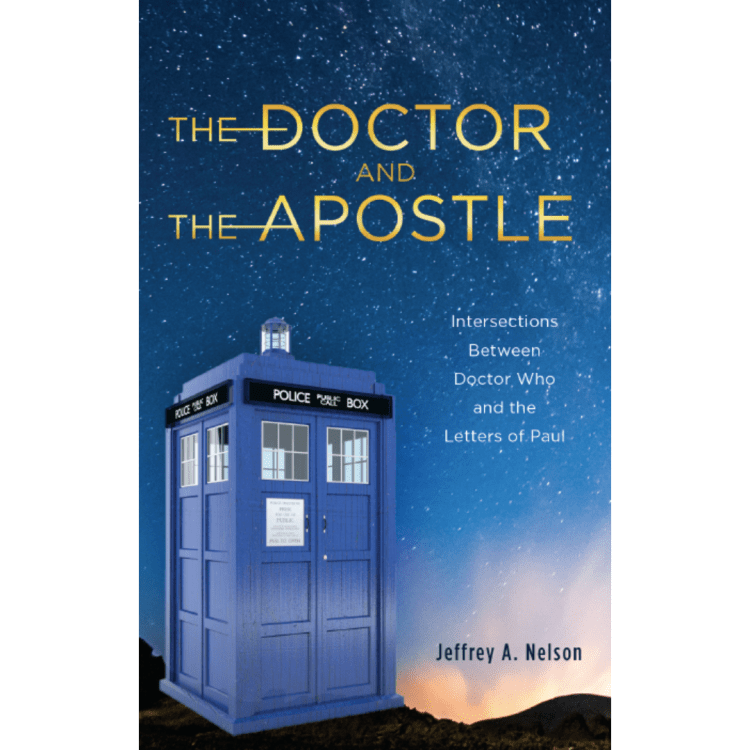
Below is an excerpt from my book, The Doctor and the Apostle: Intersections Between Doctor Who and the Letters of Paul.
Both The Doctor and Paul strive to help others see a different way of evaluating strength and wisdom, and they each struggle to convince others of the alternative possibilities.
While The Doctor does not always succeed in showing compassion toward his arch-enemies the Daleks, he nevertheless attempts to do so in several cases, particularly with Davros. In part due to his only knowing war in his developmental days and later his charge to come up with a way to defeat the Kaleds’ enemies, Davros always insists that things like love, kindness, and sympathy are weaknesses. He and the Daleks only see the universe in terms of winning and losing; of domination or being dominated. And so they conclude that the only way to exist is to exterminate all those whom they see as lesser beings because they are not able to fight back.
On more than one occasion, The Doctor tries to give the Daleks the benefit of the doubt that they can change. There are times when they show signs of progressing forward from their destructive ways, and The Doctor acts in hope that they can know a different way of existing alongside other species.
In the two-part story of “Daleks in Manhattan” and “Evolution of the Daleks,” for instance, the Tenth Doctor meets a small remnant of Daleks who are hatching a plot to merge themselves with humans so that their species will endure. After a successful test run, The Doctor rushes to help them continue their work. Unfortunately, when the other Daleks realize that their new merged subject displays a desire to live in peace with others, they kill him and give up their plan. Where The Doctor had hoped for a change in how they categorized strength and weakness, the Daleks resisted it and insisted to remain as they were.
Paul also struggles not only with how believers among the Corinthians see these categories of strength and wisdom, but with how they view him and his ministry. He comes to them in a condition that to some doesn’t seem as attractive or engaging or articulate as some other apostles with whom they had a relationship, and something about who he is and how he expresses himself does not hold appeal for them the way others who don’t suffer from his ailments do.
Paul’s solution is to point the community to the cross and to remind them that God does not think in terms of strength and wisdom the way they do. God does not reward those who are already strong as if they earned something, but instead lifts up and renews those who are weak. God does not only speak through those who are already able to do so at a high level, but instead reveals wisdom through what many may deem foolish.
Both The Doctor and Paul push back against simplistic ways of seeing how the universe works. They challenge the notion that there is only one way to be strong; that only peace may come through victory over someone else. To Davros’ dismay, The Doctor protects humanity and others from the Daleks’ plots to exterminate them, refusing to accept their mentality that only the strong—that is, only the most aggressive and violent—survive. And Paul takes great pains to show that strength and wisdom are not just in the most popular or charismatic, but in many other forms according to God’s turning conventions on their heads through Jesus.
Unfortunately for those who hear The Doctor’s and Paul’s arguments, these alternatives that they present are more difficult and take greater care and consideration. Dividing the world into stark categories of friend and enemy, worthy and unworthy, those who deserve care and those who deserve punishment, is too easy. This mentality ignores the complexity of existence and of individuals, as well as the possibility of redemption and restoration.
What is true strength? Is it the eradication of all difference; the coercion of someone to the “right” way of life under threat of exclusion or worse? Or might it be, as both The Doctor and Paul show, the more careful consideration of what could happen in the future if even a small amount of kindness or forgiveness were shown today? The former, with its black and white thinking and its simple dualistic conception of reality, is much easier: it doesn’t require nearly as much thought and it doesn’t ask as much of its adherents. The latter, with its blend of hope, mercy, and intention, invites people into a longer and more demanding process of listening, interaction, and entering into another’s story.
Paul encourages his hearers and listeners to consider where they started: “not many of you were wise by human standards, not many were powerful, not many were of noble birth. But God chose what is foolish in the world to shame the wise; God chose what is weak in the world to shame the strong” (1 Cor. 1:26-7). He encourages them to think about where they started and what insights and growth they have experienced since someone began to guide them in love. That intentional showing of regard began to open them to God’s calling in their lives. It is not unlike The Doctor choosing to help Davros as a boy, hoping that this small act of rescue may help change his conception of mercy; will help him realize that such actions are strong, even if they aren’t as clear-cut.
Time and again, both figures advocate for something more demanding, yet also more rewarding. What seems weak actually requires more strength, and likewise leads to a stronger community, whether in Corinth, Earth, Skaro, or any number of other places in the universe. This approach may seem weak when compared to conventional concepts, but committing to what it asks requires greater wisdom to consider what could be possible, and greater strength to help bring those possibilities into existence.
 Jeffrey A. Nelson