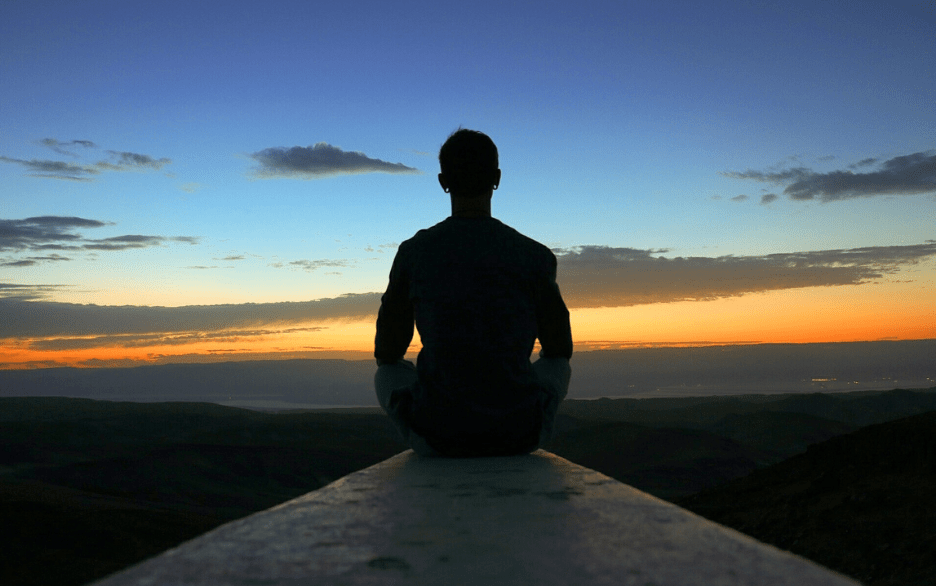
When I chose Center as my word for this year, I knew that I wanted to incorporate a daily meditation practice into whatever else I might end up doing while exploring this word. I’ve had intentions to do this with other words in the recent past, but this time doing so seemed more essential than in times past.
For one thing, exploring one’s own center seems to entail practices that involve inward-facing elements. Meditation–as with most other forms of prayer–feature such elements, and so this would be part of the cornerstone of this year’s word-based observances.
I confess that I haven’t always been good at this sort of practice, despite being a spiritual director and writing several books on prayer. Like most others, I have found it difficult to make the time for it; to prioritize it in the midst of family and work obligations. I’ve also had difficulty with sitting still. I can be a fidgety person, always needing to have some part of my body busy, and I haven’t always had confidence in myself to stay focused long enough for such a practice (this issue is one of the big reasons for why I wrote Prayer in Motion).
Overcoming that difficulty was another reason for renewing such a practice this year.
My meditation time has been very simple, and that’s the biggest reason why, at least so far, I’ve found success doing it. Here’s what I do:
- I sit in my chair, feet planted on the ground and muscles as relaxed as I can consciously make them.
- I pull up some calming music (this YouTube channel has been my favorite).
- I set a timer for 10 minutes (I started with 5 minutes and worked my way up after building confidence that I could do it).
- I sit relaxed, palms up, taking deep breaths. To help keep my mind from wandering, I silently repeat a word or brief phrase.
There aren’t necessarily any deep revelations that arise during this time, though the possibility is not out of the question. However, I do come out of it feeling more relaxed and less rushed. And due to practicing this every day, I’ve gotten to the point where when the timer goes off, I’m surprised it’s over already.
I recently finished a book by Jamie Kreiner titled The Wandering Mind: What Medieval Monks Tell Us About Distraction. It details some of the ways monks have attempted to remove distraction from their focus on a holy life, including renouncing possessions, cloistered living with minimal furnishings, and self-deprivation. Some practices that Kreiner shares are so extreme as to be counter-productive (and sometimes comical), but others actually seem translatable for modern use.
Take, for instance, their approach to meditation:
For Christian monks, meditation involved a distinctive mix of what scholars today would call directive techniques and thematic structures: their meditations were purposeful and concentrative and worked like their memories did, by association. To meditate on a concept, to think about what something was or meant, a monk searched her memory for something related to it. Then she’d build on that association, and the next, and the next. The goal was a gradual agglomeration of memories that evolved into something much more revealing than any single-sided view could be. It was an exploratory, probing way of thinking. It was a form of prayer but also an act of discovery and creation. It was a means to stretch closer to God, because to think more deeply about the world was to decode the communications that he was constantly sending. It was also a tactic to set the mid in motion without letting it wander aimlessly.
This practice of focusing on a concept or scenario is akin to some of the meditations in Ignatius of Loyola’s Spiritual Exercises. At times he suggests a Bible story, usually from one of the Gospels, in which to immerse oneself so as to imagine the sights, sounds, and smells of the moment depicted. At other times, he makes up his own scenario on which to focus that depicts some spiritual truth.
I’ve begun incorporating this focus in my own meditation as well. Sometimes I’ll focus on family memories and activities, at other times it has been ministry-related ones. I don’t think that I yet have a firm handle on this, but I’m feeling more comfortable with it. All the reason to continue.
Regardless, I’m learning how to do nothing. And in doing so, I think it’s leading me toward something.
 Jeffrey A. Nelson